I gave an introduction and a quick demo of the Fort Vancouver Mobile app to Dr. Katy Barber and her Intro to Public History class from Portland State University a couple of weeks ago. The group was really interested in the project and wanted to hear more, so I was invited back to Fort Vancouver today and gave a full demo, despite the rain and wind. During the demo, the app asks the user to take a photo at the site, so I used that opportunity to snap this image of a dedicated group of Pacific Northwest students, braving the weather, to get a look at the FVM app, how it worked, and what it might mean for historical interpretation of the future:
#fvmobile
Fort Vancouver Mobile - A video overview
Courtesy of: Research Assistant Aaron May of Washington State University Vancouver's Creative Media and Digital Culture program. Produced in 2011.
Video highlights from the apps (36-minute version)
This montage provides a sampling of some of the video media in the Fort Vancouver Mobile apps. This app is much more than just a video distribution system, but these videos show the variety of content, from expositional segments to new journalism to those intended to prompt the development of interactive narratives.
Wednesday, October 31, 2012
Monday, October 29, 2012
WSU News coverage of Hartzog Award, and the new NEH grant
More extensive coverage about the Hartzog Award and the recent NEH grant award, from WSU News:
Oppegaard teaches and does research in Vancouver for WSU’s Edward R. Murrow College of Communication, in partnership with The Creative Media and Digital Culture program. He was selected from among the nearly 80,000 volunteers -- working throughout Washington, Oregon, California, Idaho, Nevada and Hawaii – who competed for the 2012 George and Helen Hartzog Awards for Outstanding Volunteer Service.
In addition, Oppegaard just received a $19,421 grant from the National Endowment for the Humanities (NEH) to expand his smartphone-based work into the realm of tablet computers. Last year, the NEH provided a $50,000 "digital start-up” grant to begin the project.
To that end, Oppegaard’s research is pioneering new ways to share history and enhance the "We the People” project.
This "We the People” grant will fund the production of a tablet app and initial research into its use in middle school history classes, he said. "Potentially, this app could be used nationwide, in partnership with Verizon through the NEH's EDSITEment program.”
The phone app is designed specifically to be used at the Fort Vancouver National Historic Site, allowing visitors to engage both digitally and with their physical surroundings, he said. The tablet app is designed to be used away from the site.
The "Fort Vancouver Mobile” app uses geolocation technology in smartphones and tablets to help tailor the experience of visiting the fort grounds to the specific visitor at the particular place in which the person is exploring. Depending on where the visitor is standing, the apps deliver costumed re-enactment videos, still-image slides, animations, maps audio files, music and interviews with authoritative sources that depict the historic significance of each location and 1840s living conditions. Each location also offers visitors opportunities to interact, and ways for them to create their own media, as a method of participating in the interpretation of the history.
For example, the app describes the story of a Hawaiian pastor, William Kaulehelehe, who was brought in the 1840s to Fort Vancouver by the Hudson’s Bay Company. Oppegaard said Hawaiians were transferred to the fort as low-paid employees, somewhat like indentured servants. The role of Hawaiians is a part of Northwest history that isn’t often told, he said. With the app, though, visitors not only get to learn about the Hawaiian influence, but they also get to make media that relates to what they learn.
These apps are free, available in the standard markets for each platform, and found by searching "Fort Vancouver Mobile.”
Oppegaard hopes the mobile app eventually can be expanded to more areas of the Fort Vancouver National Historic Site as well as used as a model for apps at parks across the nation.
VANCOUVER, Wash. - Brett Oppegaard, assistant professor at Washington State University Vancouver, has been named the National Park Service’s (NPS) regional volunteer of the year for his assistance in developing mobile device applications during more than 5,000 hours of volunteer service.
Oppegaard teaches and does research in Vancouver for WSU’s Edward R. Murrow College of Communication, in partnership with The Creative Media and Digital Culture program. He was selected from among the nearly 80,000 volunteers -- working throughout Washington, Oregon, California, Idaho, Nevada and Hawaii – who competed for the 2012 George and Helen Hartzog Awards for Outstanding Volunteer Service.
In addition, Oppegaard just received a $19,421 grant from the National Endowment for the Humanities (NEH) to expand his smartphone-based work into the realm of tablet computers. Last year, the NEH provided a $50,000 "digital start-up” grant to begin the project.
Remote sites and classrooms
The most-recent NEH grant is part of the "We the People” initiative, "designed to encourage and enhance the teaching, study and understanding of American history, culture, and democratic principles.”
To that end, Oppegaard’s research is pioneering new ways to share history and enhance the "We the People” project.
"We are focused on mobile media use at place-based attractions, such as National Park Service sites and other informal learning environments,” said Oppegaard. "We also are intrigued by ways in which formal learning environments, such as middle school history classrooms, can use mobile technologies to extend education into informal learning spaces.”
This "We the People” grant will fund the production of a tablet app and initial research into its use in middle school history classes, he said. "Potentially, this app could be used nationwide, in partnership with Verizon through the NEH's EDSITEment program.”
The phone app is designed specifically to be used at the Fort Vancouver National Historic Site, allowing visitors to engage both digitally and with their physical surroundings, he said. The tablet app is designed to be used away from the site.
First interactive NPS application
Volunteering at the Fort Vancouver National Historic Site, Oppegaard developed and produced mobile apps for iPhone, iPad and Android platforms that are the only interactive applications of their kind in the National Park system, according to Cassie Anderson, Fort Vancouver ranger.
The "Fort Vancouver Mobile” app uses geolocation technology in smartphones and tablets to help tailor the experience of visiting the fort grounds to the specific visitor at the particular place in which the person is exploring. Depending on where the visitor is standing, the apps deliver costumed re-enactment videos, still-image slides, animations, maps audio files, music and interviews with authoritative sources that depict the historic significance of each location and 1840s living conditions. Each location also offers visitors opportunities to interact, and ways for them to create their own media, as a method of participating in the interpretation of the history.
For example, the app describes the story of a Hawaiian pastor, William Kaulehelehe, who was brought in the 1840s to Fort Vancouver by the Hudson’s Bay Company. Oppegaard said Hawaiians were transferred to the fort as low-paid employees, somewhat like indentured servants. The role of Hawaiians is a part of Northwest history that isn’t often told, he said. With the app, though, visitors not only get to learn about the Hawaiian influence, but they also get to make media that relates to what they learn.
These apps are free, available in the standard markets for each platform, and found by searching "Fort Vancouver Mobile.”
One of seven nationally
As the NPS’ Pacific West region’s representative for 2012, Oppegaard is one of seven volunteers nationally to receive the regional 2012 George and Helen Hartzog Award for Outstanding Volunteer Service. Those seven will compete later this year for the national Hartzog Award. The awards recognize the time, talent, innovation and work contributed to national parks through the Volunteers-In-Parks Program.
Oppegaard hopes the mobile app eventually can be expanded to more areas of the Fort Vancouver National Historic Site as well as used as a model for apps at parks across the nation.
Friday, October 26, 2012
More on the Hartzog award
The recent Hartzog Award announcement is being featured right now on the home page of The Edward R. Murrow College of Communication:
With this press release:
Tuesday, October 23, 2012
An alternative tablet app interface
During our design discussions about the Grand Emporium of the West tablet app interface, the question was raised: What if we used a historical image, with some added colorization and animation, as the territory upon which people touch?
That started multimedia designer Marsha Matta on a quest to experiment with such an image, to see what could be done. The full animation is only available in the app, and it shows a gentle transition between the images below. But here are screen shots that demonstrate the preliminary results, beginning with an original drawing, created by George Gibbs, in about 1850:
So each of the colorized pieces above could be touched on the tablet app, triggering the media box that contains the text, audio, video, animations and such, plus the rest of the button functions. What do you think?
That started multimedia designer Marsha Matta on a quest to experiment with such an image, to see what could be done. The full animation is only available in the app, and it shows a gentle transition between the images below. But here are screen shots that demonstrate the preliminary results, beginning with an original drawing, created by George Gibbs, in about 1850:
This would be the start state of the app:
It would gradually colorize into this:
Then the colors would fade on anything that wasn't touchable.
So each of the colorized pieces above could be touched on the tablet app, triggering the media box that contains the text, audio, video, animations and such, plus the rest of the button functions. What do you think?
Monday, October 22, 2012
The George and Helen Hartzog Awards for Outstanding Volunteer Service
I feel deeply honored and appreciative of the recent announcement that I was chosen as the Pacific West Region's National Park Service representative for the George and Helen Hartzog Awards for Outstanding Volunteer Service this year. This award, named for the former director of the National Park Service, and his wife, who both highly valued the VIP (Volunteer-in-Park) program, recognizes exceptional service within the federal agency's nationwide system. The Pacific West Region -- with national parks in Hawaii, California, Washington, Oregon, Idaho, Nevada, and parts of Montana -- attracted nearly 80,000 volunteers last year, at such parks as Yosemite National Park, Hawaii Volcanoes National Park, Mount Rainier National Park, Joshua Tree National Park, Redwood National Park, etc. To be chosen as the top contributor, among that amazing group, is mind blowing, and an honor I share with everyone who has contributed to this project so far. Thank you all!
Here is the press release making the announcement:
A visit by Portland State U's Public History class
Dr. Katy Barber and her Intro to Public History class from Portland State University visited Fort Vancouver recently, and, as part of the program, the students had a chance to hear about the FVM project, which included a short demo. Here's a pic of all of us afterward (I'm on the far right; Chief Ranger Greg Shine is just one person over, to my right, in the hat):
The response of the class to the FVM project was so positive that we now are talking about bringing the group back for a longer demo and creating more partnerships between PSU and WSU Vancouver related to mobile means of interpreting public history.
Sunday, October 14, 2012
Growing mobile page views at NPS sites
Interesting stats about the growing trend of mobile page views at National Park Service sites nationwide, generated by Michael Liang, Visual Information Specialist in the NPS Northeast Regional Office, Philadelphia, shared by Fort Vancouver's Chief Ranger Greg Shine, from the Facebook #diginterp discussion group:
In 2009, mobile page views accounted for 0.5 percent of the Internet traffic to NPS sites. In 2010, that number quadrupled to 2 percent. The next year, 2011, saw another quadrupling, to 8 percent, and in 2012, 15 percent of all page views at NPS sites come via mobile devices. Definitely a trend to watch!
Thursday, October 11, 2012
FVM project featured in open campus letter about WSU research
The Washington State University Vancouver newspaper, The VanCougar, published this week an open campus letter from Professor Emeritus Robert Bates, who is the director of the office of research and graduate education. In that letter, Dr. Bates mentions the FVM project as the first example of "exciting and innovative research opportunities for you to become involved in ..."
That was very kind of both Dr. Bates and The VanCougar to place us in that position. Thank you!
Wednesday, October 10, 2012
FVM app on the National Park Service site, as part of NPS Getaways
For the next week, Fort Vancouver is being featured on the main National Park Service Web site, as a NPS Getaway:
Which includes this paragraph about our project:
Monday, October 8, 2012
Old Apple Tree app research recap
Dr. Michael Rabby and I spent our Saturday at The Old Apple Tree Park in Vancouver, Wash., gathering data about app media forms. Here are a couple of pics:
This first one, I couldn't help but show this Friends of Trees mascot what we were doing. ...
The second one comes from The Columbian, the local newspaper, and its coverage of the event; I'm standing in the tan vest in front of the tree, looking for the next person to test:
Overall, the research went well. The weather was warm and sunny, definitely a better testing situation than some of my winter research, when, in the rain, very few people want to test outdoor apps. The glare on the screen from the sun did cause some temporary usability issues, and test subjects had to turn to make a shadow, or stand next to a sign that created a bit of shade, to compensate. Otherwise, though, Michael and I were able to run two tests every 10 minutes for five hours, which seemed about as fast a pace as humanly possible. More test devices on site, and more researchers conducting tests, would have increased our data yield at this event, since there were plenty of people in the area to enlist for testing. Next year, as long as it doesn't rain, I think I'll plan to double the staffing and see how that goes. We certainly learned a lot from the experience, including the creation of several new research questions.
This first one, I couldn't help but show this Friends of Trees mascot what we were doing. ...
The second one comes from The Columbian, the local newspaper, and its coverage of the event; I'm standing in the tan vest in front of the tree, looking for the next person to test:
Friday, October 5, 2012
Old Apple Tree Festival research this weekend, 11 a.m. to 4 p.m. Oct. 6
Michael Rabby, Brady Berkenmeier and I will be at the Old Apple Tree Park on Saturday, testing a new research tool we developed (with Joseph Oppegaard), focused upon the Old Apple Tree, the oldest such fruit tree in the Pacific Northwest. Every year, the city of Vancouver celebrates the tree and its history with this October festival. Last year, FVM collaborator Will Luers documented the festival in a short film, which we then edited into research clips, designed to test media forms at the site, delivered through mobile devices, phones and tablets. I probably shouldn't say any more than that right now, before the data is collected, but, if you want, come to the Old Apple Tree Park during the festival, and try out the free app. We'll be there from roughly 10:30 a.m. to 4 p.m. ... If you can't make it during that time, but still want to participate in our research, just send an email with the details of your interest, to: fortvancouvermobilebeta@gmail.com, and we'll set up something, by appointment.
NEH Grant No. 2!
The official paperwork just about has cleared every hurdle, so we finally can announce that the National Endowment for the Humanities has enjoyed and appreciated our Fort Vancouver Mobile work so much, it has presented us with a second grant, a "We the People" Special Projects grant, in the amount of $19,400, to expand the FVM work onto tablet computers. That pushes our external funding for this project over the $100,000 mark. Congratulations, all!
This tablet app, titled the Grand Emporium of the West, will be focused on informal STEM learning within formal educational environments, targeted toward middle school students in history classes across the country. This NEH partnership, with Verizon and the NEH educational arm called EDSITEment, will include research into interactive tablet computer activities that further engagement and comprehension of 19th century culture and society on the western frontier, through a focus on the life and times of people living at Fort Vancouver. This extension of museum science will include digital media objects that model period exploration, discoveries, and survival techniques, through such participatory topics as cooking, traveling, and artistic documentation, which then require the students to engage in the activities through various means. I'll post more updates here as we develop the free app, which we expect to launch around February of next year. If you want to become a beta tester of this app, please let me know through fortvancouvermobilebeta@gmail.com.
Tuesday, October 2, 2012
Welcome to the team: Richard Kriehn
![]() |
| Richard Kriehn |
"Richard Kriehn is the Program Coordinator for the School of Music and also teaches violin, guitar class, Survey of Music Literature and Introduction to Music Technology. He also holds the position of principle second violin for the Washington/Idaho Symphony. Mr. Kriehn earned his BM from Boise State University and his MA in Music from Washington State University. Mr. Kriehn has performed with the Boise Philharmonic, Arkansas Symphony, Nashville Chamber Orchestra and the Alabama Symphony. He also served as concertmaster and a founding member of Boise Baroque Chamber Orchestra (Boise, Idaho). Before moving to the Pacific Northwest, he and his family lived just outside of Nashville, Tennessee. While in Tennessee, he toured with Travis Tritt, Aaron Tippin and Michael Peterson, was a member of the Nashville Mandolin Ensemble and was a member of the bluegrass group “1946.” When Richard wasn’t traveling, he transcribed mandolin books for Mel Bay Publications (four to date) and performed studio work. During his five years in Nashville, he appeared at many diverse venues: Country Gold Festival, Kumamoto, Japan; The Rosie O’Donnell Show (ABC); The Grand Ole’ Opry (TNN); Walker, Texas Ranger (CBS); Farm Aid 2000 (TNN). One of his favorite musical memories, however, happened right here in the Palouse. In October of 2006, he was asked to be a guest performer on “A Prairie Home Companion” when the show came through Pullman and broadcast a live radio show from Beasley Coliseum."
Friday, September 28, 2012
FVM app 1.95 in Apple App store now
Update your app; lots of new changes, including reorientation of the Kane module to vertical (thanks again, Brady!)
Thursday, September 20, 2012
New WSU Vancouver chancellor notes FVM project as model of community engagement
Mel Netzhammer, the new chancellor at Washington State University Vancouver, and also a communication scholar, praised the Fort Vancouver Mobile project as one of the primary examples of the university's efforts to balance community engagement and classroom education, in this Oregonian story, published this week.
Tuesday, September 11, 2012
Grand Emporium of the West interface
We have a new National Endowment for the Humanities app under development, not even in the Alpha stages of coding yet, but I wanted to share the prototype progression of the main interface. This app is being designed specifically for tablet computers (Apple and Android), and our idea was to use a historic map of Fort Vancouver to enable users to access content about the fort by simply touching different parts of the map. Because of the perspective needed, though, and the details to be included, no historic map would work, so we brought in star multimedia designer Marsha Matta to build a new map, based on historical styles, to serve this purpose.
Here are some of the examples we gave her:
And here is the amazing interface she has been building:
The final version will be available in the app, when it is released. So if you want to see the last few stages of development, check back.
Monday, September 10, 2012
Dr. Rabby, testing the FVM project
Dr. Michael Rabby of WSU Vancouver recently visited Fort Vancouver and tested the Kanaka module. Here is his photo at the site, taken by the app, documenting his arrival and participation in building the history of the place. Thanks, Michael!
Monday, August 6, 2012
FVM project featured in Mana Magazine
Mahalo to Mary Alice Ka'iulani Milham, for writing this great piece about the FVM project in Mana Magazine's July/August issue. Mana is an independent magazine, created specifically for the Hawaiian community. ...
Friday, August 3, 2012
Amazing dedication: Troy in the bake house oven
FVM videographer Troy Wayrynen, just before leaving the U.S. to photograph images at the London Olympics (check out that work here), shot our video piece on preparing seabiscuits (rough cut below). ...
To get one of the perspectives, Troy actually climbed into the bake house oven and let ranger Mike Twist light a fire with him inside. Here is a snapshot of Troy inside the oven, munching on a seabiscuit:
Some of the footage he shot during the oven piece is in here:
To get one of the perspectives, Troy actually climbed into the bake house oven and let ranger Mike Twist light a fire with him inside. Here is a snapshot of Troy inside the oven, munching on a seabiscuit:
Some of the footage he shot during the oven piece is in here:
Visit by Sola Adesope
Our Pullman pedagogical partner, Dr. Sola Adesope, recently visited Vancouver and spent some time at Fort Vancouver, getting a demo of the app, and talking with us about the development of the project. He had many great ideas to share.
Here is a photo of Sola using the app, at one of the points in which the app asks the user to make a self portrait:
Wednesday, July 11, 2012
Our little piece of stunt coral
Columbian reporter Tom Vogt recently wrote about the piece of stunt coral we used in our Kanaka module. His story covers many of the basics of the situation, but, in short, we had a beautiful piece of historic coral that inspired us to tell the story of native Hawaiians at Fort Vancouver. The coral was introduced through this video:
And we regularly brought it back into play in the story through such examples as this piece:
And this piece, in which the stunt coral really earned its keep:
And we regularly brought it back into play in the story through such examples as this piece:
And this piece, in which the stunt coral really earned its keep:
Saturday, June 30, 2012
FVM at the ELO conference in W.V.
Dene Grigar recently presented a paper on her work with the Fort Vancouver Mobile project at the 2012 Electronic Literature Organization conference in Morgantown, W.V., the site of West Virginia University. This photo shows Grigar during her talk, playing a video featuring Fort Vancouver's chief ranger Greg Shine.
Tuesday, June 12, 2012
Coverage of the regional mobile app market
Dene Grigar and I were the only educators at this recent mobile technology forum in Portland, featuring senators Maria Cantwell and Ron Wyden, and including a presentation by us. This is how The Oregonian covered it.
The Columbian, with a follow-up cheer
The Vancouver Business Journal
And a few pics here from ISITE Design
The Columbian, with a follow-up cheer
The Vancouver Business Journal
And a few pics here from ISITE Design
FVM at DHSI 2012
The Fort Vancouver Mobile project was featured prominently in discussions last week at the Digital Humanities Summer Institute in Victoria, British Columbia, where Creative Media and Digital Culture faculty (Dene Grigar, John Barber, Will Luers, Brett
Oppegaard and Nicholas Schiller) taught a week-long course called “Creating Digital Humanities Projects for the Mobile
Environment.” The international group of scholars taking this course -- from such universities
as Yale, Emory, Howard, Michigan, and Toronto -- learned about conceptualizing
space, coding and programming, and developing mobile architecture, design and
content. The proof-of-concept apps produced included programs for special
library collections, literary walks, and teaching foreign languages.
Saturday, June 9, 2012
FVM app public launch: June 9, 2012
Just a quick post to commemorate the official launch of the Fort Vancouver Mobile app today. More than two years in the making, this app has brought together the talents and efforts of more than 100 people, and it was a great joy to see all of those using and having fun (and learning) with the app today. This is a major milestone moment for FVM. So I want to pause for a second to thank everyone who made it happen! I feel enormous gratitude toward each and every one of you! Special thanks are due to: Dene Grigar, Greg Shine, Joe Oppegaard, Brady Berkenmeier, Troy Wayrynen, Marsha Matta, Forrest Burger, Deva Yamashiro, Kapuanani Antonio, Fred Kemp, Tracy Fortmann and all of the Fort Vancouver staff. ... Additional recognition should be extended as well to Berkenmeier, director of the "Kane's Wanderings" module, for his continued commitment and advancement of the app. Besides the Kane piece, the "Kanaka" module also was a part of this launch. In addition, we gave out about 200 cards with installation instructions today, so I will look forward to checking analytics and viewing this day from behind the scenes as well, to get a better sense of the push we made. Will keep you posted on what we learn from today. ...
Tuesday, May 29, 2012
ICA presentation on FVM project
I just returned from an exciting International Communication Association conference in Phoenix, Ariz., which featured a two-day preconference focused specifically on Mobile Communication, Community, and Locative Media.
At that preconference, which had representatives from 16 different countries in attendance, I had the honor of presenting a talk titled "Looking into the Past to See Our Future: Mobile Devices as Dynamic Historical Interpretation Tools." My goal was to express the idea that mobile communication does not have to carry the bags of old media with it. We can look at the mobile medium with fresh eyes and see it as something with new affordances and new possibilities, including its potential for historical interpretation and journalism (the second part being my emphasis for a project this summer). The talk went well. Many people expressed interest in those ideas and the Fort Vancouver project. The momentum continues to build!
Friday, May 18, 2012
Fort Vancouver Mobile's public launch coming up: June 9
WSU Vancouver's version ...
Here's the press release:
Contact:
Brett Oppegaard, project coordinator
fortvancouvermobile@gmail.com
360-521-8150 (c)
Behind-the-scenes blog: www.FortVancouverMobile.net
May 18, 2012
Want to learn about history at the
Fort Vancouver National Historic Site in a new way? There’s an app for that, as
the Fort Vancouver Mobile app will make its public debut on June 9, in
conjunction with a Brigade Encampment as well as National Get Outdoors Day.
The free
app -- funded by grants from the National Endowment for the Humanities, the
Clark County Commissioners, and Washington State University Vancouver – is the
first interpretation-oriented app in the National Park Service system. This
research project has been developed by a core of about 20 scholars, many in The
Creative Media and Digital Culture program at WSU Vancouver, with the support
of students as well as new media professionals in the region and bolstered by
the volunteer efforts of more than 100 people throughout the community. WSU
Vancouver faculty member Brett Oppegaard is coordinating the project, and
fellow faculty members Dene Grigar, John Barber, Will Luers, Michael Rabby,
Sola Adesope, and Steve Fountain all have contributed to the project.
While many
apps provide textbook-like information about people or places in history, or
connect users to wayfinding tools, the Fort Vancouver Mobile app distinctly is
designed as an interface for narrative immersion into a historical place. Those
who download the app (through the Android or Apple markets) will have access to
interactive stories connected to physical landmarks, which help to create a
synthesis of the digital and the physical at Fort Vancouver.
On June 9,
the focus of the festivities will be on the debut of the first two modules
created for the app:
· “Kanaka”
– About the native Hawaiians, or “kanakas,” who began coming to Fort Vancouver
in the 1820s to serve as laborers. Many toiled in the sawmill, but others, such
as the protagonists of this story, pastor William Kaulehlehe and wife, Mary
Kaai, were drawn to this place for other reasons. Created in partnership with
the Ke Kukui Foundation.
· “Kane’s
Wanderings,” about Irish-born painter Paul Kane, who stopped at Fort Vancouver in
the winter of 1846-1847, in the midst of traveling and documenting the people
and places of the Pacific Northwest. Created as part of a WSU Vancouver class
on Digital Storytelling.
Other modules, such as a story focused on gender and women’s
issues, will be released at later special events. A behind-the-scenes blog on
the project is being kept at: FortVancouverMobile.net.
The Fort Vancouver
National Historic Site, which attracts more than 1 million annual visitors to
its Vancouver, Wash., campus, has been seeking out younger patrons
through various pioneering approaches to historical interpretation, including
podcasting, digital archiving and social media feeds. The Fort Vancouver Mobile
team, including Chief Ranger Greg Shine, was assembled in response to the
potential offered by mobile devices, such as iPhones and Droids. Through investigations
into the affordances of these integrated media devices, clips of audio, video,
animation, and text, have been mixed to be delivered to visitors at the most
ideal times in the most ideal places at the site to generate a sense of Fort
Vancouver’s story.
The Fort Vancouver National
Historic Site, 1001 E. Fifth St., Vancouver, Wash., will offer the Brigade
Encampment and related activities, including the app launch, from 10 a.m. to 4
p.m. June 9. Admission to the event is free, and download cost of the app is
free.
For more information about the
Fort Vancouver Mobile project, please contact: Brett Oppegaard, 360-521-8150, fortvancouvermobile@gmail.com.
Fort Vancouver Mobile project earns a Research Mini-Grant from WSU Vancouver
WSU Vancouver announced this week that the Fort Vancouver Mobile project has earned a $4,000 Research Mini-Grant to extend its investigations of place-based media into journalistic realms. This grant primarily will be used to buy equipment for producing new media and conducting research on the site, while a new accompanying app will be built to look at labor issues over the past 200 years at the old sawmill site near Fort Vancouver. More details about this effort will be posted later in the summer.
Wednesday, May 16, 2012
Redesign: News of the Era
The primary protagonist of the Kanaka module, William Kaulehelehe, wrote a letter to his hometown newspaper, The Ka Nupepa Kuokoa, in the 1860s, basically complaining that he wasn't receiving the copies he had paid for, and he wanted those. As a former newspaper writer, I found that complaint to transcend time, and I looked closer at when those letters were being sent. One of them was dated April 1865, the same month that General Lee surrendered at Appomattox, the Civil War ended, Lincoln was assassinated, Booth was on the loose, and the S.S. Sultana sunk, which is the worst marine disaster in U.S. history. No wonder William wanted to know what was going on! ... In that time period, the newspaper was print, television, radio, and Internet bundled into a single and slow analog delivery system. Without a newspaper, everything was word of mouth, and news could take months to travel across the country. So we decided to make an alternate reality game of sorts out of this, by embedding summaries of period newspapers in the landscape at Fort Vancouver and asking visitors to walk around the site to find different issues (or the lost Kaulehelehe newspapers, as we dubbed them).
Here is the version of this newspaper imagery we will launch with on June 9, showing an account of the first "base ball" game happening in the 1840s; Fort Vancouver took up the craze soon thereafter:
We also created newspapers for other major national events, such as Lincoln's assassination (with text placed on those images within the app):
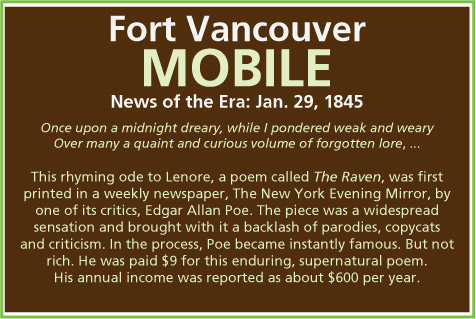
And the interesting moment in time in which literature arose through newspaper printings, such as Poe's The Raven, which first was produced in a newspaper:
At the end of each newspaper sequence, users get to take a quiz, to test either explicit knowledge transfer or to find out what users found most interesting about the newspaper summary. These newspaper sequences did begin as digital collages, but gradually grew into the more even and sophisticated designs above. Here are a couple of examples of the starting points:
Subscribe to:
Posts (Atom)
More about the fort
More about mobile storytelling ...
Phase One background
- William Kaulehelehe background
- Hawaiians at Fort main
- Hawaiians at Fort brochure
- Polynesian Cultural Center (Hawaii)
- Leaving Paradise book by Barman and Watson
- Crossing East (NPR excerpt on Hawaiians)
- Crossing East (radio series)
- Hula's history (NPR piece)
- Ke Kukui Foundation
- Na Hawaii
- Kalama ceremony (video)
- Clark County gov's Hawaiian link


.jpg)


.png)